Email Marketing A/B Testing – A Complete Guide
“`html
Email Marketing A/B Testing Strategies That Actually Move the Needle in 2026
Most B2B marketers treat email like a coin flip. Write something, hit send, hope for the best. Then wonder why open rates plateau at 18% and click-through rates barely clear 2%. The problem isn’t the channel — email still delivers a median ROI north of $36 per dollar spent, según Litmus’s 2024 State of Email report. The problem is running campaigns without structured feedback loops.
That’s exactly what email marketing A/B testing strategies fix. Not because testing is glamorous, but because it replaces opinion with evidence. You stop arguing about subject lines in Slack and start letting your subscribers tell you what works.
This guide is for CMOs and founders who want a repeatable system — not a one-time experiment. We’ll cover what to test, how to structure it, what metrics actually matter, and how this connects to a broader organic content engine that reduces your dependence on paid acquisition.
Why A/B Testing in Email Belongs Inside a Larger Content System
Before we get tactical, let’s zoom out. Email doesn’t operate in isolation. The same audience reading your nurture sequences is also reading your blog, your LinkedIn posts, your case studies. If your content is inconsistent across those touchpoints — different voice, different value prop, different offers — your email performance will always have a ceiling.
The CMOs and founders we work with who see compounding email results are the ones who’ve connected their email program to an organic content system. Their blog posts feed email topics. Their email data informs blog priorities. It’s a loop, not a ladder. If you’re still relying on paid ads to feed top-of-funnel while neglecting organic, read how we help B2B companies replace paid ads with organic blogs — because the same discipline that makes email testing work applies across the whole system.
Con eso claro, let’s talk strategy.
What Email Marketing A/B Testing Actually Is (and Isn’t)
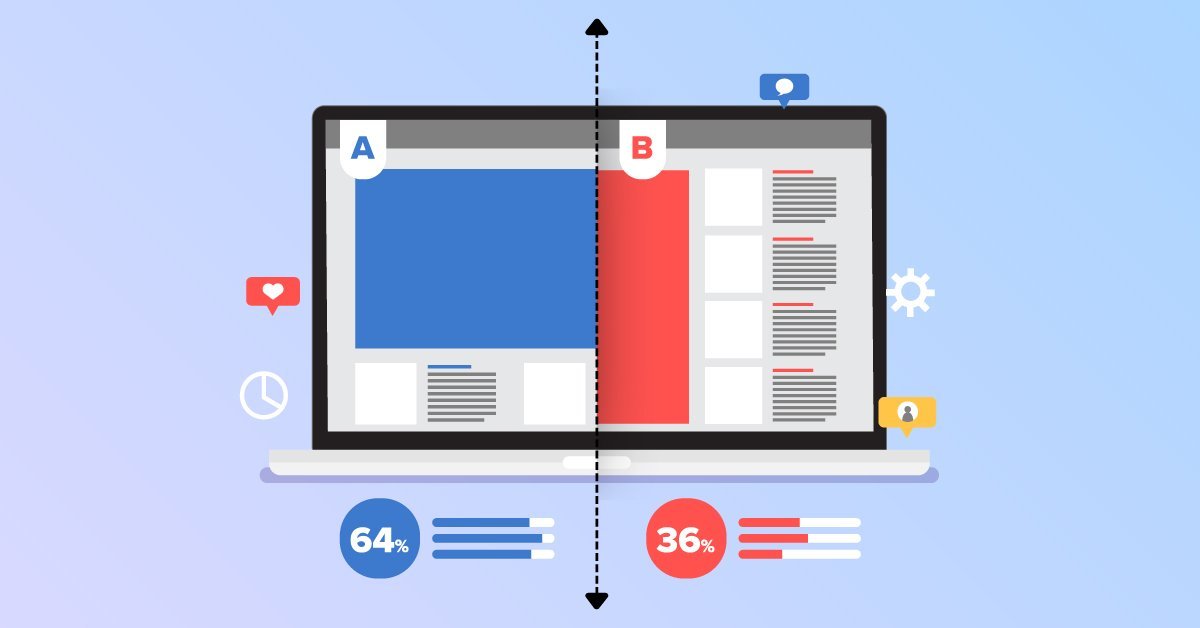
A/B testing — also called split testing — sends two versions of the same email to separate, randomly divided segments of your list. One variable changes between versions. Everything else stays identical. You measure which version hits your target metric harder, then roll the winner to the rest of your list or use it as the baseline for your next campaign.
Simple in concept. Messy in execution if you skip the fundamentals.
What it isn’t: sending two completely different emails to see which one “does better.” That’s not a test — that’s noise. If you change the subject line, the CTA copy, the image, and the send time simultaneously, you have no idea which change drove the difference. Isolation is everything.
The Variables Worth Testing (Ranked by Impact)
Not all variables are created equal. Some will move your metrics 15% overnight. Others might nudge things 1-2% after three months of testing. Here’s where to focus your energy, especially if you’re early in building a testing cadence.
1. Subject Lines
The highest-leverage variable in most B2B email programs. Subject lines determine whether the email gets opened at all — nothing else matters if this fails. Test length (short punchy vs. descriptive), tone (direct vs. curiosity-driven), personalization tokens, and question formats versus statements. A 2023 Campaign Monitor study found personalized subject lines improved open rates by up to 26% — but the effect varies dramatically by industry and list quality, so don’t assume that number applies to your audience without testing it.
2. Preview Text
The most underused real estate in email. Preview text is the 40-90 characters that appear next to or below the subject line in most inboxes. Most senders either ignore it or let their ESP auto-pull the first line of the email body. Test preview text that extends the subject line’s hook versus preview text that adds a separate value cue. The combo of subject + preview is what sells the open.
3. Call-to-Action Copy and Placement
Once someone opens your email, the CTA is what drives revenue. Test the copy itself (“See the Full Case Study” vs. “Read Now”), button color, placement (above the fold vs. after context), and whether one CTA or multiple CTAs per email performs better for your specific audience. For most B2B nurture sequences, one clear CTA outperforms three competing ones — but that’s a hypothesis, not a rule. Test it.
4. Send Time and Day
Tuesday at 10am is the most-cited “best time to send” in the industry. Which means it’s also the most crowded inbox moment. Test against it. Try Thursday afternoons. Try early Monday before the week’s noise accumulates. The right send time is audience-specific, and the only way to know yours is to test it with your actual list, not industry averages.
5. Email Length and Format
Long-form emails with full context versus short emails with a single link. Plain text versus HTML-designed templates. Heavy image use versus copy-forward layouts. These variables matter more than most people realize, especially in B2B where decision-makers are reading on mobile in between meetings. Sin chamullo — a well-structured plain-text email often outperforms a polished HTML template in click-through rate because it reads like a human wrote it.
How to Structure a Test That Produces Usable Data
Good testing protocol isn’t complicated, but it requires discipline. Here’s the framework we use with clients.
- Test one variable at a time. Always. No exceptions if you want clean data.
- Define your success metric before you send. Open rate for subject line tests. Click-through rate for CTA and content tests. Conversion rate for offer tests. Choosing the metric after seeing the data is how confirmation bias enters your testing program.
- Segment randomly, not by demographics. Your ESP should handle this. Both groups need to be statistically equivalent — same mix of industries, company sizes, and engagement levels.
- Run tests on adequate list sizes. As a general benchmark, you need at least 1,000 subscribers per variant (2,000 total) to reach statistical significance on open rate tests. For click-through tests, you need more. If your list is smaller, focus on directional learning rather than statistical certainty.
- Document everything. What you tested, when, to what segment, with what hypothesis, and what the results were. Most teams skip this and end up re-running tests they’ve already done.
Reading the Results Without Fooling Yourself
This is where most testing programs fall apart. Someone sees Version B beat Version A by 3 percentage points and declares it “the winner” — then builds an entire content strategy around a result that wasn’t statistically significant.
Statistical significance tells you how likely the difference between your variants is due to the actual change versus random chance. Aim for 95% confidence before acting on a result. Most reputable ESPs (Mailchimp, Klaviyo, HubSpot, ActiveCampaign) calculate this for you. If yours doesn’t, use a free A/B test significance calculator — there are dozens available online.
Also watch for short-term vs. long-term effects. An aggressive discount subject line might spike open rates in one test but train your list to expect discounts, hurting long-term engagement. Measure the downstream impact, not just the immediate metric bump.
Building a Testing Cadence: From One-Off Experiments to a System
One A/B test is a data point. Twelve A/B tests over twelve months is a competitive advantage. The goal is to build testing into your standard operating procedure — not something you do when you “have time.”
A realistic cadence for most B2B teams: one test per month, cycling through variables. Month one: subject lines. Month two: CTA copy. Month three: send time. Month four: email length. By the end of a year, you have a documented profile of what your specific audience responds to. That’s an asset your competitors are unlikely to have built — because most of them are still guessing.
Connect your findings to your broader content calendar. If curiosity-driven subject lines consistently outperform direct ones, that tells you something about your audience’s mindset that should inform your blog headlines, LinkedIn posts, and even sales outreach. Your email testing data isn’t siloed — it’s a signal about how your buyers think.
2026 Reality Check: What’s Changed and What Still Works
Apple’s Mail Privacy Protection, introduced in 2021 and now mature across most iOS email clients, inflated open rate data by auto-loading tracking pixels. By 2026, open rates in isolation are a compromised metric for a significant portion of most B2B lists. This doesn’t mean open rates are useless — they still directionally indicate subject line performance — but they’re no longer the clean primary metric they once were.
Shift your primary success metrics toward click-through rate, reply rate, and downstream conversions. These are harder to fake and more directly tied to business outcomes. Build your A/B testing strategies around metrics that survive infrastructure changes, not ones dependent on pixel tracking that privacy tools are actively blocking.
Start Here If You’re Building This From Scratch
If you haven’t run a single A/B test yet, don’t start with the complex stuff. Start with subject lines on your next three campaigns. Write two versions — one direct, one curiosity-driven. Split your list 50/50. Measure click-through rate at 48 hours. Document the result. Do it again next month with a different variable.
That’s it. The sophistication comes with repetition. The insight comes from doing it consistently over time, not from running one elaborate multivariate test and calling it a strategy.
Email marketing A/B testing strategies aren’t a silver bullet — they’re a discipline. And like most disciplines, the teams that win are the ones who show up every month, document what they learn, and let the data compound.
If you’re building a content marketing system where email, blog, and organic search work together — and you’re ready to reduce what you’re spending on paid ads — here’s the framework we use with B2B clients to make that work. The same rigor that makes email testing effective applies to the whole system.
Want us to audit your current email program and identify the highest-impact variables to test first? Reach out to the Social Peak Media team — we work with CMOs and founders who are serious about building content that pays off long-term.
— Jose Villalobos, Social Peak Media
“`