The $3.4 Trillion Opportunity: Marketing to Hispanic Americans in 2025
“`html
The Hispanic American Marketing Buying Power Opportunity: What $3.4 Trillion Means for Your Growth Strategy in 2026
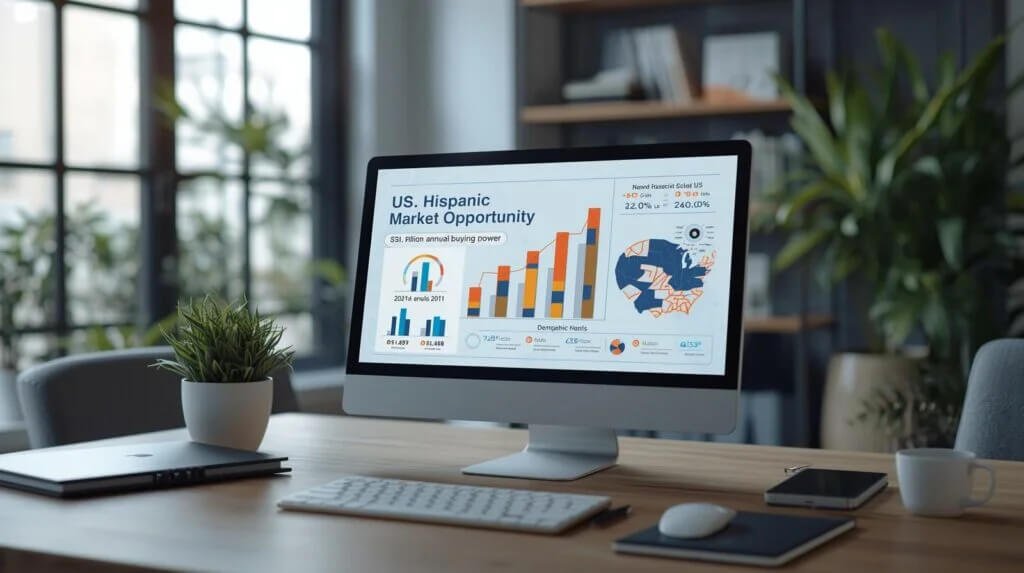
$3.4 trillion. That number is larger than the entire GDP of the United Kingdom. It surpasses every other minority consumer segment in the United States — combined. And it belongs to a demographic that is younger, faster-growing, and more digitally engaged than almost any other group your brand is trying to reach right now.
That is the Hispanic American marketing buying power opportunity. And most U.S. companies are still treating it like a footnote.
Not a core strategy. Not a primary audience. A translation project, maybe. A separate budget line that gets cut first. A campaign that runs in October for Hispanic Heritage Month and goes dark in November.
That approach is not just a missed opportunity. At this scale, it is a measurable competitive disadvantage — and the window to course-correct is narrowing as more category-aware brands move in.
The Scale Is Not a Projection. It Is Already Here.
Some numbers get cited so often they lose their weight. Let’s restore the weight on these.
- $3.4 trillion in annual Hispanic buying power in the United States — sourced from the Latino Donor Collaborative (2023), not an estimate, a documented economic output figure
- 65 million+ Latinos currently living in the U.S., more than the entire population of France (U.S. Census Bureau, 2024)
- 29% — projected share of the total U.S. population by 2060, meaning nearly 1 in 3 Americans will identify as Hispanic or Latino (U.S. Census Bureau projections)
- 3x — the rate at which Latino-owned businesses are growing versus the national average for small businesses (Stanford Latino Entrepreneurship Initiative, 2023)
- 73% of Hispanic consumers say they are more loyal to brands that advertise in Spanish or demonstrate genuine cultural understanding (Horowitz Research)
These are not aspirational estimates. They are current, documented, and sourced from the most rigorous demographic and economic research available in the country. The market is not coming. It is here.
Why Most Brands Are Still Getting This Wrong
The gap between the size of this opportunity and the marketing investment directed toward it is, frankly, hard to explain on purely strategic grounds. U.S. advertisers spend roughly 4–6% of their total ad budgets targeting Hispanic audiences — a segment that represents nearly 19% of the population and a disproportionate share of consumer spending growth.
Part of the problem is a mental model issue. Many CMOs still frame Hispanic marketing as a niche play — culturally specific, linguistically complex, requiring a separate team and a separate brief. That framing gets it backwards.
The Hispanic American consumer is not a niche. She is your mainstream. He is your next-generation B2B buyer. They are the first-generation entrepreneur who just crossed $1M in revenue and needs the financial products, SaaS tools, and professional services to scale. Treating this audience as a translation problem rather than a primary growth segment is exactly the kind of strategic blind spot that hands market share to competitors who figured it out earlier.
Sin chamullo: the brands winning Hispanic consumer loyalty right now are not the ones with the biggest budgets. They are the ones with the most culturally coherent strategies.
What “Culturally Coherent” Actually Means in 2026
Cultural coherence is not about language selection alone, though language matters. It is about whether your brand shows up in a way that reflects genuine understanding of who Hispanic Americans are — not as a monolith, but as a diverse, multi-generational, highly heterogeneous community with distinct regional identities, heritage countries, acculturation levels, and media behaviors.
A few things that separate culturally coherent brands from brands that are simply translating:
- They market in Spanish where Spanish is preferred — and in English where it is not, without assuming one size fits all. U.S.-born Hispanic millennials often prefer English content but respond more emotionally to Spanish-language brand moments in specific contexts.
- They understand the bicultural identity — the “both/and” of being American and Latino, not the “either/or” that so many campaigns accidentally imply.
- They reflect real community breadth — Mexican American consumers in Texas, Puerto Rican communities in New York, Cuban Americans in Miami, Central American communities in Los Angeles are not interchangeable audiences. Heritage, dialect, cultural reference points, and media consumption patterns differ meaningfully.
- They invest consistently, not seasonally — Hispanic Heritage Month campaigns that vanish the rest of the year signal to audiences exactly how much the brand actually values them.
Claro, none of this is simple. But the brands that do the work are seeing measurable returns in loyalty, word-of-mouth, and long-term lifetime value that outperform general market benchmarks in category after category.
The Cross-Border Dimension: US-LATAM Is One Ecosystem, Not Two Markets
Here is a layer that even sophisticated marketers frequently underestimate: the U.S. Hispanic market and the broader Latin American market are not separate strategic conversations. For a significant portion of Hispanic American households, there is an active, ongoing economic and cultural relationship with origin countries — remittances, family commerce, cross-border brand awareness, bilingual digital media consumption.
A brand that builds authentic credibility with Hispanic American consumers in the U.S. is simultaneously building brand equity in Mexico, Colombia, Guatemala, El Salvador, and beyond. And a brand with strong positioning in LATAM markets carries trust signals that resonate with first-generation U.S. Hispanic consumers.
This is not a theory. It is how brand decisions actually get made in bicultural households. Your U.S. Hispanic strategy and your LATAM strategy should be developed in dialogue with each other — not in separate silos managed by separate agencies with no shared brief.
This is the core argument behind our Bilingual / Cross-Border Marketing pillar: the U.S.-LATAM corridor is a single strategic ecosystem, and the brands that treat it that way have a structural advantage over those still thinking in geographic boxes.
What the 2026 Landscape Adds to This Conversation
A few developments in 2025–2026 that sharpen the urgency:
- AI-generated content is flooding Spanish-language digital channels — creating an authenticity gap that well-executed, culturally fluent brand content can now fill more visibly than ever
- Hispanic purchasing power has continued growing faster than inflation, with the 2024 LDC report updating estimates upward from earlier baselines
- Latino-owned business formation accelerated post-pandemic, creating a fast-growing B2B audience of Hispanic entrepreneurs and decision-makers who are actively underserved by most B2B marketing programs
- Spanish-language connected TV and streaming viewership hit new highs in 2025, shifting the premium media landscape in ways that open new reach opportunities for brands willing to invest
The opportunity is not static. It is compounding. Which means the cost of delay is compounding too.
Three Questions Every CMO Should Be Asking Right Now
You do not need a full strategy overhaul to start moving on this. You need honest answers to three questions:
- What share of our current marketing investment is reaching Hispanic American audiences? If it is below 15% of your U.S. budget, you are almost certainly underinvesting relative to market size.
- Is our current Hispanic marketing strategy culturally built or just linguistically translated? Spanish-language copy on English-language creative is not a strategy. It is a placeholder.
- Are we treating our U.S. Hispanic strategy and our LATAM strategy as connected? If those conversations are happening in different rooms with different teams, you are leaving synergies — and credibility — on the table.
These are not rhetorical questions. They have specific, actionable answers — and the gap between where most brands are and where they need to be on this is closer than most leadership teams realize.
The Opportunity Is Real. The Window Is Not Infinite.
The Hispanic American marketing buying power opportunity is not a trend to watch. It is an economic reality that is already reshaping which brands win and lose in U.S. markets — and which will continue to do so at greater speed through the rest of this decade.
The brands that are building genuine, culturally coherent relationships with Hispanic American consumers right now are not being altruistic. They are being strategic. They are investing in the audience that will drive a disproportionate share of U.S. consumer spending growth for the next 30 years.
The question is not whether this audience is worth reaching. At $3.4 trillion, that question answers itself. The question is whether your organization is set up to reach them well — or whether you are still running October campaigns and calling it a strategy.
At Social Peak Media, we work with CMOs and founders building bilingual, cross-border content strategies that connect authentic brand voice to Hispanic American and Latin American audiences — without losing rigor or business focus. If you are ready to build a strategy that matches the scale of this opportunity, let’s talk. And if you want to go deeper on the U.S.-LATAM marketing ecosystem, start with our Bilingual / Cross-Border Marketing resource hub.
— Jose Villalobos, Social Peak Media
“`