Programmatic Advertising and Real-Time Bidding (RTB): The Future of Digital Ad Strategies in 2025
“`html
Programmatic Advertising vs Organic Strategy ROI: What CMOs Need to Know in 2026
Here’s the budget conversation no one wants to have out loud: your programmatic spend is climbing, your CPMs are rising, and your CAC is doing the same. Meanwhile, the brand down the street is generating qualified pipeline from blog posts they published two years ago. So which model actually wins on ROI — programmatic advertising or organic content strategy? The answer is more nuanced than most media vendors will admit, and it has serious implications for how you allocate in 2026.
This isn’t an either/or argument. But if you’re a CMO or founder trying to reduce customer acquisition costs without gutting pipeline, you need a clear-eyed view of what each channel actually delivers — and when. See our full pillar on Organic vs Paid: CAC Reduction Through Content for the broader framework. Here, we go deep on programmatic.
What Programmatic Advertising Actually Is (No Jargon)
Programmatic advertising is automated ad buying. Instead of negotiating placements manually with publishers, software handles it — using algorithms, real-time data, and machine learning to decide which ad goes to which user, on which platform, at what price, in milliseconds. No sales calls. No insertion orders. Just data-driven decisions at scale.
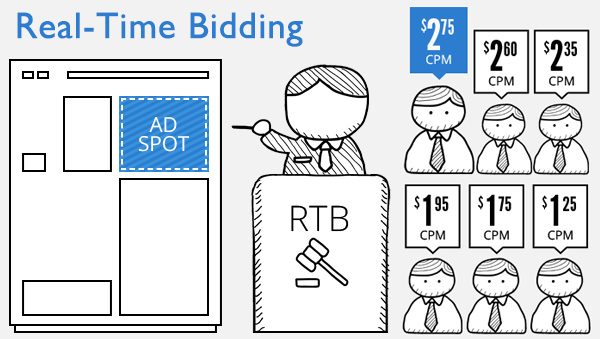
Real-Time Bidding (RTB) is the auction layer that sits inside programmatic. Every time a user loads a page or opens an app, an auction fires. Advertisers bid on that impression. The highest relevant bid wins. The whole thing happens faster than a blink. The key players in this ecosystem are:
- Demand-Side Platforms (DSPs) — where advertisers buy inventory across multiple networks through one interface
- Supply-Side Platforms (SSPs) — where publishers list and sell their available ad space
- Ad Exchanges — the marketplace connecting buyers and sellers in real time
- Data Management Platforms (DMPs) — the audience intelligence layer that informs targeting decisions
By 2026, programmatic has expanded well beyond display. Connected TV (CTV), digital out-of-home (DOOH), audio, and in-app inventory are all running programmatic auctions. It’s the operating system of modern paid media.
The ROI Case For Programmatic
Programmatic’s core promise is efficiency. You’re not paying for eyeballs — you’re paying for the right eyeballs, at the right moment, with the right message. When it works, it works fast. A well-configured DSP campaign can reach a precise audience segment within hours of launch. For product launches, event promotion, retargeting warm leads, or defending branded search — programmatic is hard to beat on speed.
The targeting capabilities have also matured significantly. In 2026, contextual targeting has largely replaced third-party cookie dependence (post-deprecation), and AI-driven bid optimization has reduced wasted spend on irrelevant impressions. Programmatic campaigns that are properly structured — with clean audience segments, frequency caps, and creative testing protocols — can drive meaningful short-term conversion lifts.
That said, the ROI story has a ceiling. Every impression costs money. The moment you stop funding the machine, the traffic stops. CAC tends to rise over time as audiences saturate and CPMs increase with competition. According to industry benchmarks, average programmatic CPMs across display formats have increased year-over-year since 2022, with premium inventory on CTV pushing $25–$45 CPM in competitive verticals. For B2B companies with longer sales cycles, those numbers get uncomfortable fast.
The ROI Case For Organic Content Strategy
Organic content — SEO-driven articles, thought leadership, pillar pages, case studies — operates on a completely different economic model. The cost is front-loaded (production, optimization, distribution) and the returns are back-loaded. That makes it a hard sell in a quarterly-targets world. But the compounding math is real.
A piece of content that ranks on page one for a high-intent keyword can generate qualified traffic for three, five, or even ten years after publication. Every click is effectively free. CAC from organic search consistently outperforms paid channels in B2B when measured over a 12-to-24-month window. HubSpot’s own data has long shown that inbound leads cost 61% less than outbound leads — and organic content is the engine behind inbound.
The EEAT factor matters more than ever in 2026. Google’s ranking systems now weight Experience, Expertise, Authoritativeness, and Trustworthiness heavily — which means shallow, generic content doesn’t rank. But content built around genuine expertise, real data, and clear editorial perspective does. That’s actually good news for brands willing to invest in quality. It raises the barrier to entry for competitors running low-effort content programs.
The honest limitation: organic takes time. Claro. A new domain or a brand-new content program typically takes six to twelve months to see meaningful organic traction. For companies that need pipeline now, that lag is a real constraint — not a marketing talking point to dismiss.
Programmatic Advertising vs Organic Strategy ROI: A Direct Comparison
Here’s how these two channels compare across the metrics that matter most to CMOs and founders focused on CAC reduction:
- Time to first result: Programmatic — hours to days. Organic — months to a year.
- Cost structure: Programmatic — ongoing variable spend (stop paying, stop running). Organic — upfront production cost, near-zero marginal cost per visit at scale.
- CAC trajectory: Programmatic CAC tends to rise with competition. Organic CAC tends to decrease as content compounds.
- Audience trust: Organic content builds brand authority over time. Programmatic ads carry inherent skepticism — users know they’re being advertised to.
- Data dependency: Programmatic relies heavily on audience data quality, platform algorithms, and third-party signals. Organic relies on search intent signals and content relevance.
- Scalability: Programmatic scales with budget immediately. Organic scales with content volume and authority — slower but more defensible.
- Attribution: Programmatic offers better short-term, last-click attribution. Organic content often influences multi-touch journeys that are harder to credit in standard models.
What the 2026 Landscape Changes
Two developments are reshaping this comparison in 2026. First, the full deprecation of third-party cookies in Chrome (completed in 2024) has forced programmatic platforms to rebuild targeting infrastructure around first-party data, contextual signals, and cohort-based models like Google’s Privacy Sandbox. This has created a transitional period where targeting precision — programmatic’s main advantage — has dipped for many advertisers who weren’t prepared with strong first-party data assets.
Second, AI-generated content flooded the internet through 2023–2025, tanking the organic rankings of sites relying on volume-over-quality strategies. Google’s Helpful Content updates and EEAT-weighted ranking systems are actively rewarding depth, expertise, and genuine human perspective. Sin chamullo — this is a real window of opportunity for B2B brands willing to publish authoritative, experience-backed content right now, while competitors are still producing generic AI slop.
The Smarter Framework: Use Both, But Know the Role of Each
The brands reducing CAC most effectively in 2026 aren’t choosing between programmatic and organic — they’re assigning each channel the job it’s actually built for. Programmatic handles bottom-funnel retargeting, event-driven campaigns, account-based advertising, and competitive defense. Organic content handles top-of-funnel authority building, mid-funnel education, and long-tail demand capture.
The strategic mistake is using programmatic to do the job organic should own — specifically, broad awareness at scale to cold audiences. That’s where CAC explodes. And the opposite mistake is expecting organic content to generate pipeline inside a 90-day sprint. It won’t.
If you’re a CMO trying to reduce CAC without cutting growth, the question isn’t “programmatic or organic?” It’s: at what stage of the buyer journey is each channel the highest-leverage tool? Build the content infrastructure that compounds over time. Use programmatic to accelerate specific, time-sensitive conversion moments. Measure both with appropriate time horizons. That’s where the ROI math works.
Explore our full guide on Organic vs Paid: CAC Reduction Through Content — including channel-by-channel CAC benchmarks, content ROI modeling, and the hybrid budget frameworks we use with B2B clients.
Ready to Build a Content Strategy That Actually Compounds?
At Social Peak Media, we help B2B CMOs and founders build organic content programs that reduce CAC over time — without abandoning the paid channels that move pipeline today. If you’re spending on programmatic and wondering why organic isn’t pulling its weight, let’s talk. The problem is almost always structural, and it’s fixable.
Book a strategy call with our team and we’ll audit your current channel mix against your CAC targets — no pitch deck, no fluff.
By Jose Villalobos
“`