
Should You Edit Your Podcast Yourself or Hire a Pro?
“`html
Podcast Editing Outsourcing vs DIY: The Decision That Costs CMOs More Than They Think
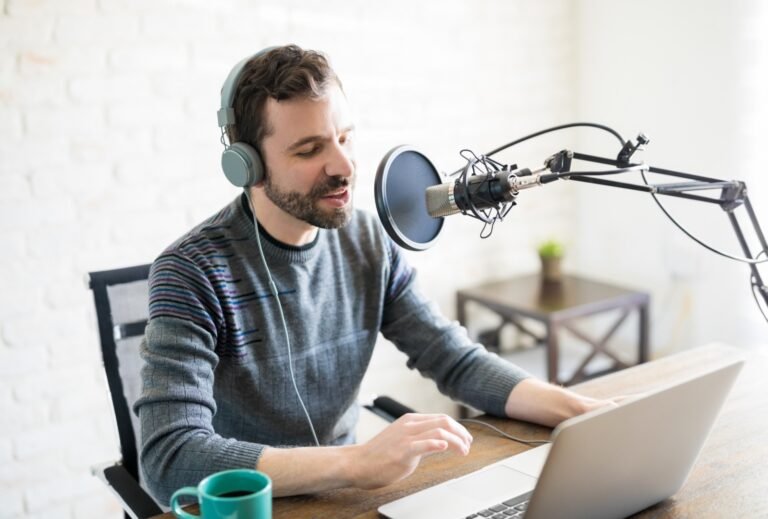
You record a solid episode. The conversation flows, the insights land, the guest was sharp. Then you open your DAW and stare at 47 minutes of waveform. What happens next determines whether your podcast becomes a growth asset or a production bottleneck. For CMOs and founders running content-led growth strategies in 2026, the podcast editing outsourcing vs DIY debate isn’t really about audio quality. It’s about where your highest-leverage hours go.
This isn’t a hobbyist’s guide. This is for leaders who’ve already committed to podcasting as a distribution channel and need to make the production model work at scale. Let’s break it down sin chamullo.
Why This Decision Matters More in 2026
Podcast consumption hit record levels in 2025, and B2B shows are now a primary touchpoint in enterprise buying cycles. Gartner research consistently shows buyers complete 60–70% of their decision journey before talking to sales — and podcasts are quietly doing heavy lifting in that dark funnel. That means production quality and publishing consistency are no longer nice-to-haves. They’re brand signals.
A poorly edited episode with background hiss, uneven levels, and awkward silences tells your prospect something about how you run your operation. A show that disappears for three weeks because you couldn’t find time to edit tells them something worse.
The Real Cost of DIY Podcast Editing
DIY editing looks cheap on a spreadsheet. It isn’t. The honest math includes your hourly rate multiplied by every hour you spend inside Audacity or Adobe Audition instead of doing the work only you can do.
A single 45-minute episode typically requires 2–4 hours of editing for someone without deep experience — removing filler words, balancing levels, cutting dead air, adding intros and outros, exporting for multiple platforms. At a founder or CMO rate of $200–$500/hour, that’s $400–$2,000 of opportunity cost per episode. Most shows publishing weekly run 50+ episodes per year. Do that math once and the conversation changes.
- Time cost: 2–4 hours per episode for non-experts, pulling directly from strategy and revenue-generating work
- Consistency risk: Production quality varies episode to episode as skills develop unevenly
- Learning curve tax: Mastering noise reduction, EQ, compression, and multitrack editing takes months of deliberate practice
- Burnout factor: Many founder-hosted shows go dark because editing became the bottleneck that killed momentum
That said, DIY has real advantages that shouldn’t be dismissed — especially at the beginning.
When DIY Podcast Editing Actually Makes Sense
- You’re in a pre-revenue or early-stage phase where cash genuinely constrains every decision
- You want intimate creative control over pacing, tone, and what gets cut — and that control directly reflects your brand voice
- Your show is low-frequency (monthly or bimonthly) and editing doesn’t create a recurring bottleneck
- You’re building audio production as a core internal competency, not just a distribution channel
Claro, there’s also something to be said for understanding the craft before you hand it off. Founders who’ve edited their own episodes tend to be better at briefing editors, catching quality issues, and knowing what “good” actually sounds like. That institutional knowledge has value.
What Podcast Editing Outsourcing Actually Buys You
Professional podcast editing services in 2026 range from $50–$300 per episode depending on episode length, turnaround time, and the scope of deliverables. Some agencies bundle editing with show notes, social audiograms, and transcript SEO optimization — which changes the value equation significantly.
Here’s what outsourcing actually delivers beyond clean audio:
- Publishing consistency: A professional editor on a defined SLA means your show ships on schedule, regardless of what else is on fire that week
- Listener retention: Professional-grade EQ, compression, and noise reduction measurably improve average listen duration — the metric platforms use for algorithmic distribution
- Brand credibility: Audio quality is a proxy for operational credibility in B2B contexts; enterprise buyers notice
- Founder/CMO bandwidth: You get those 2–4 hours per episode back to focus on guest relationships, content strategy, and revenue
- Scalability: Moving from weekly to twice-weekly doesn’t require doubling your personal time investment
The compounding effect here is underrated. A founder who reclaims 150–200 hours per year from editing tasks and redirects that toward pipeline development or strategic content isn’t just saving time — they’re reallocating capacity toward higher-leverage outputs.
Outsourcing vs DIY: A Side-by-Side Framework
Use this to pressure-test your current approach or make the initial call with clarity:
- Budget under $500/month: DIY or semi-DIY with AI-assisted tools (Descript, Riverside.fm’s Magic Clips, Adobe Podcast Enhance) to close the quality gap
- Publishing 2+ episodes per month: Outsource — the volume makes DIY unsustainable at executive-level hourly rates
- Show tied directly to pipeline: Outsource without hesitation; this is a revenue-adjacent asset and production quality is non-negotiable
- Solo host, simple format: DIY is viable with AI tools handling leveling and filler removal; reserve human editors for complex multi-guest episodes
- Team already stretched: Outsource; internal bandwidth is a finite resource and podcast production will always lose in a prioritization battle against urgent deliverables
The Hybrid Model Most Growth-Stage Teams Miss
The binary of “do it yourself or hire a pro” misses a third option that many scaling B2B teams are running in 2026: AI-assisted DIY with human QA. Tools like Descript’s Underlord, Adobe Podcast Enhance, and Cleanfeed have brought broadcast-quality noise reduction and filler-word removal within reach of non-editors. A junior marketing hire can run an episode through these tools in 30–45 minutes and get 80% of the way to professional quality.
The remaining 20% — nuanced pacing, tonal consistency, multi-track balancing, strategic cuts — is where a professional editor earns their rate. Routing only the final polish pass to a freelancer cuts per-episode costs while maintaining quality standards. This hybrid model typically runs $25–$75 per episode in outside spend, with 45–60 minutes of internal time. For most growth-stage teams, that’s the right point on the curve.
What to Look for When Outsourcing Podcast Editing
Not all editing services are equal. When evaluating vendors, CMOs and founders should pressure-test on these dimensions:
- Turnaround SLA: Can they consistently deliver within 48–72 hours? Slow turnaround kills publishing schedules
- B2B audio experience: Editing a business interview show is different from editing a narrative podcast; confirm relevant portfolio
- Scope clarity: Do deliverables include show notes, chapters, audiograms, and transcript files — or just the audio file?
- Revision policy: How many rounds are included? Unlimited revisions sounds generous until you realize it signals an imprecise briefing process
- Communication cadence: Will you have a dedicated editor who learns your style, or a rotating pool with no institutional memory?
The Strategic Bottom Line for CMOs and Founders
The podcast editing outsourcing vs DIY question resolves quickly when you frame it correctly: is audio production a core competency for your business, or is it a means to an end? For most B2B operators, it’s the latter. Your competitive advantage lives in your ideas, your network, your positioning, and your ability to build an audience that trusts your point of view.
The mechanics of removing a cough from a recording do not compound. Your thinking does. Outsource accordingly.
If you’re building a podcast as a serious content marketing channel — not a side project — treat production like any other business function: define the output standard, build or buy the capability to hit it consistently, and protect your highest-leverage time for the work that only you can do. That’s not a podcasting decision. That’s a growth decision.
For a broader look at how podcasting fits into a full content marketing system, see our CMO and Founder Growth Playbooks — including frameworks for content distribution, audience building, and demand generation at scale.
Running a B2B podcast and not sure if your production model is holding your growth back? Talk to the Social Peak Media team — we help CMOs and founders build content systems that actually scale.
By Jose Villalobos
“`