Best Podcast Recording Tools and Apps for 2025 | Top Picks for Pro Audio
“`html
Podcast Recording Tools & Apps for 2025 (And What Actually Matters for B2B Shows)
Most podcast gear guides are written for hobbyists chasing studio sound in a spare bedroom. This one isn’t. If you’re a CMO or founder using a podcast as a B2B content channel—generating pipeline, building authority, warming cold audiences—your tool selection has different stakes. Bad audio kills credibility faster than a weak argument. And the wrong platform wastes your team’s time every single episode.
Here’s what’s actually worth your attention when evaluating podcast recording tools and apps in 2025, with an eye toward what’s shifting heading into 2026.
What B2B Podcasters Actually Need From Recording Tools
The criteria matter before the product list does. A solo creator optimizing for Spotify charts has different requirements than a revenue team recording weekly thought-leadership content with rotating executive guests across time zones.
Ask these four questions before you sign up for anything:
- Audio quality ceiling: Does the tool capture lossless or near-lossless audio, even over remote connections? Compressed audio signals low production value—and in B2B, that reflects on your brand.
- Remote recording reliability: Guest interviews are the backbone of most B2B shows. You need a platform that records each participant locally and uploads asynchronously, so a bad WiFi connection doesn’t ruin the take.
- Multi-track output: Separate audio tracks per speaker means your editor can fix a guest’s volume, remove a cough, or cut a tangent without touching your host’s audio. Non-negotiable for professional post-production.
- Workflow friction: How many clicks between “record” and “published file”? Time is money. Sin chamullo—if your team dreads the upload and export process, consistency will suffer.
Best Desktop Podcast Recording Software for 2025
Adobe Audition
Best for: Teams that already live in the Adobe ecosystem and need full post-production control in one place.
Adobe Audition remains the professional standard for desktop recording and editing. Multi-track sessions, spectral frequency display for noise removal, and deep integration with Premiere Pro make it the go-to for in-house production teams with an editor on staff. The learning curve is real—plan for onboarding time if your host is the one doing their own edits.
- Pros: Professional-grade recording, robust multi-track editing, Adobe Creative Cloud integration, consistent updates
- Cons: Subscription-based pricing, steeper learning curve than most alternatives, overkill for remote-only workflows
GarageBand (Mac)
Best for: Early-stage founders or solo hosts on Mac who want zero software cost and a clean interface.
Free on every Mac, GarageBand handles basic podcast recording competently. It won’t match Audition’s editing depth, but for a founder recording weekly solo episodes or a simple two-person local setup, it gets the job done without adding a line item to the budget. The ceiling is lower—it’s not a remote recording solution.
- Pros: Free, intuitive UI, solid for local multi-track basics
- Cons: Mac-only, limited remote capabilities, not built for complex productions
Audacity
Best for: Budget-conscious teams on any OS who need a functional free editor.
Audacity is open-source, cross-platform, and has been a reliable free option for years. The 2024–2025 versions have improved stability and added some modern UI polish. It’s not glamorous, but it records clean audio and handles basic editing without costing a dollar. Claro—just don’t expect a premium experience.
- Pros: Free, cross-platform (Windows, Mac, Linux), active development community
- Cons: Interface feels dated, no built-in remote recording, limited compared to paid DAWs
Best Remote Podcast Recording Apps for 2025
Remote recording platforms have become the core tool for most B2B podcast operations. If your guests are distributed—and they almost always are—this category deserves your primary budget allocation.
Riverside.fm
Best for: B2B teams that record video alongside audio and need a polished guest experience.
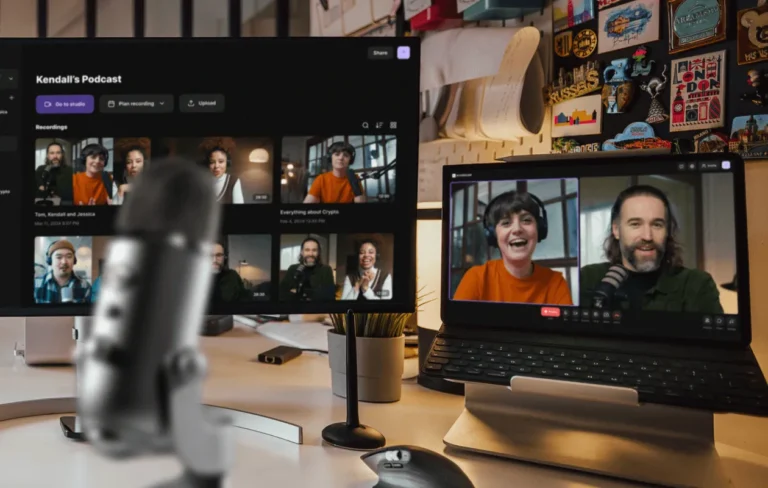
Riverside records locally on each participant’s device and uploads progressively, meaning a dropped internet connection mid-interview doesn’t destroy the session. It outputs separate audio and video tracks per speaker—a genuine operational advantage for teams with editors. The 2025 version added AI-powered transcription and a built-in clip editor for social content repurposing, which matters if your distribution strategy extends beyond the podcast feed.
Heading into 2026, Riverside has been expanding its AI production features, including automated chapter markers and highlight detection—worth watching if you’re building a lean content operation.
- Pros: Local recording per participant, separate tracks, video support, strong guest UX (browser-based, no download required), active AI feature roadmap
- Cons: Mid-tier pricing for full feature access, video storage limits on lower plans
Squadcast
Best for: Audio-first B2B shows with a focus on reliability and clean integration with post-production tools.
Squadcast has been a preferred remote recording option for serious podcast producers for several years. Its progressive upload system and lossless WAV output put it on par with Riverside for audio quality. It integrates directly with Descript, which streamlines the edit-to-publish workflow considerably. If your team edits in Descript, Squadcast is the natural recording front-end.
- Pros: Lossless audio, reliable remote recording, Descript integration, clean interface
- Cons: Less video capability than Riverside, fewer built-in content repurposing tools
Zencastr
Best for: Smaller teams or solo hosts wanting an all-in-one platform at a lower price point.
Zencastr bundles recording, post-production tools, and some distribution features into a single interface. The free tier is functional for low-volume shows. It’s not the strongest option for enterprise-level operations, but for a founder running a lean podcast as one piece of a larger content strategy, the reduced tool sprawl has real value.
- Pros: Affordable, all-in-one approach, web-based with no guest downloads needed
- Cons: Post-production features are lighter than dedicated editors, audio quality ceiling below Riverside and Squadcast
Mobile Podcast Recording Apps Worth Knowing
Mobile recording isn’t a primary workflow for most B2B operations, but it matters for field recording, event content, or executive hosts who travel constantly. Two options stand out.
Ferrite Recording Studio (iOS)
The most capable mobile DAW for podcast production on iOS. Multi-track editing, silence trimming, and noise reduction—all on an iPhone or iPad. It’s used by journalists and documentary producers who need real editing power in the field, not just a voice memo substitute.
Hi-Q MP3 Voice Recorder (Android)
Clean, reliable, high-bitrate recording on Android. Not an editing tool, but an excellent capture app when you need a dependable mobile recorder for remote or event situations. Simple by design.
What’s Changing in 2026: AI and Workflow Compression
The clearest trend heading into 2026 is AI doing more of the post-production work that currently consumes editor hours. Riverside, Descript, and emerging tools like Podcastle are building toward automated noise reduction, filler word removal, and even voice consistency correction that runs without human review.
For B2B marketing teams, this matters because it changes the economics of podcast production. If AI can compress a four-hour edit into forty-five minutes, the cost-per-episode drops—and the business case for running a consistent show gets stronger. Watch this space. The tools available in early 2026 will look meaningfully different from what’s on this list today.
The Bottom Line on Choosing Your Stack
For most B2B podcast operations in 2025, the practical answer is straightforward: Riverside.fm or Squadcast for remote recording, Adobe Audition or Descript for editing. If budget is tight, swap Audition for Audacity and Riverside’s free tier for early-stage production.
What you shouldn’t do is let tool selection become a reason to delay publishing. The best recording setup is the one your team will actually use consistently. Consistency beats perfection every time when you’re building audience trust over months and quarters.
If you want to understand how podcast content fits into a broader B2B content architecture—distribution strategy, repurposing workflow, lead generation integration—explore our pillar on Related B2B Growth Topics. That’s where the recording tools connect to actual revenue outcomes.
Start With the Right Foundation
Your podcast is a business asset, not a side project. The tools you choose shape your production quality, your team’s bandwidth, and ultimately how much your audience trusts what they’re hearing. Get the foundation right, and the content strategy built on top of it has a much better chance of delivering.
Need help building a podcast content strategy that generates real pipeline? Talk to the Social Peak Media team—we work with B2B brands to turn podcast content into measurable growth.
By Jose Villalobos
“`