Brand Purpose and Positioning Guide: Crafting a Brand That Means Something
“`html
Brand Purpose Positioning Strategy: How CMOs and Founders Build Brands That Actually Mean Something
By Jose Villalobos, Founder of Social Peak Media
Most brands are forgettable. Not because the product is bad. Because nobody inside the company could answer two questions with any real conviction: Why do we exist? And why should anyone choose us over the next option? That is the gap a solid brand purpose positioning strategy is built to close.
This is not a brand refresh exercise or a tagline workshop. It is the strategic foundation that drives what you say, who you attract, and how you grow. Sin chamullo—let’s get into it.
Why Brand Purpose and Positioning Are Revenue Levers, Not Just Brand Feelings
The Edelman Trust Barometer has been making the same uncomfortable point for years: 64% of consumers choose, switch, avoid, or boycott brands based on beliefs and values—not price, not features. That number matters even more heading into 2026, when buyer skepticism is high and attention is scarce.
For CMOs and founders, this is a positioning problem disguised as a marketing problem. When your brand lacks a clear purpose and a defined position, you end up competing on price, fighting for attention with tactics, and watching churn quietly eat your margins.
Purpose and positioning are strategic anchors. Everything else—content, campaigns, sales enablement—flows from them.
The Difference Between Brand Purpose and Brand Positioning
These two ideas are related but distinct. Conflating them is one of the most common mistakes growth-stage teams make.
- Brand purpose is your why. It answers why your company exists beyond generating revenue. It is the moral core of the organization.
- Brand positioning is your where and how. It defines the specific space you occupy in the market and why buyers should choose you over alternatives.
Purpose creates emotional connection. Positioning creates competitive clarity. Together, they make your brand both meaningful and differentiated—which is the only combination that compounds over time.
What Brand Purpose Actually Is (and What It Is Not)
Brand purpose answers one question: Why do we exist beyond making money? It is your belief system. The thing your team rallies around on a bad quarter and your customers reference when they recommend you to a colleague.
A quick framework to keep the concepts straight:
- Vision = where you are going
- Mission = what you do to get there
- Purpose = why any of it matters
Purpose is not a goal. It is an identity statement. Look at how Patagonia frames it: “We are in business to save our home planet.” That is not a campaign line. It shapes hiring, product decisions, partnerships, and pricing. At Social Peak Media, our purpose is to empower small businesses to create brand clarity, impact, and emotional connection—and that shapes every engagement we take on.
The test for a real brand purpose: could your team make a difficult business decision using it as the deciding factor? If the answer is no, it is probably just a slogan.
How to Define Your Brand Purpose: A Working Framework
Step 1: Go Back to the Origin Story
What problem made you start the company? Not the polished investor version—the real one. What were you frustrated by? What did you see that others were ignoring? The origin story almost always contains the seed of an authentic purpose.
Step 2: Name the Change You Want to Drive
What needs fixing in your industry, your community, or your customer’s life? Purpose-driven brands are not just solving a transaction. They are advancing a point of view about how the world should work. Be specific. Vague purpose (“we make things better”) is indistinguishable from no purpose at all.
Step 3: Connect It to Your Customer’s Identity
The most powerful purposes reflect something your customer already believes about themselves. When buyers align with your purpose, they are not just purchasing—they are affiliating. That is how you build a customer base that markets for you.
Step 4: Pressure-Test It Internally
Share the draft purpose with your team. Does it resonate? Does it make decisions easier? Does it feel true—or does it feel like something a consultant wrote on a whiteboard? If it does not pass the internal test, it will not survive external scrutiny.
Brand Positioning Strategy: Owning a Specific Space in the Market
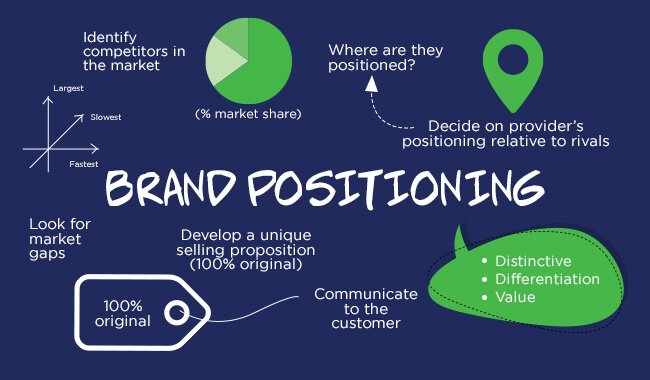
Positioning is where strategy gets competitive. Your position is not what you say you are—it is the distinct place you occupy in a buyer’s mind relative to every alternative. Getting this wrong means you are perpetually explaining yourself instead of being chosen.
A strong positioning statement has four components:
- Target audience: Who, specifically, are you for?
- Category: What market are you playing in?
- Differentiated value: What do you do that alternatives do not—or cannot?
- Proof: Why should anyone believe you?
In 2026, generic positioning is a liability. Buyers are more informed and more skeptical than ever. “We are the best quality at the best price with the best service” is not a position. It is a placeholder. The brands winning right now are the ones willing to be specific enough to exclude some buyers in order to be unmistakably right for the right ones.
Common Positioning Failures to Avoid
- Positioning to everyone: If your ICP is “any business that needs marketing,” your positioning will be invisible.
- Feature-first positioning: Features can be copied. Position on outcome and identity, not capability lists.
- Aspirational positioning with no proof: Claiming a position without evidence invites skepticism. Ground every differentiator in a verifiable result, case study, or method.
- Internal positioning that never ships: The best positioning document in the world does nothing sitting in a Google Drive. It has to show up in your website copy, sales conversations, content, and hiring language.
How Purpose and Positioning Work Together in Practice
Think of purpose as the north star and positioning as the lane you run in to reach it. A company with strong purpose but weak positioning struggles to convert belief into buyers. A company with sharp positioning but hollow purpose wins transactions but rarely builds loyalty.
Claro: the CMOs and founders who do this well are the ones who treat both as living strategy—revisited when the market shifts, when a new competitor enters, or when growth stalls and nobody can explain why.
Here is a practical check for 2026 relevance: does your current positioning account for how your buyers are making decisions differently than they were 18 months ago? Buyers are doing more research independently, they trust peer recommendations over vendor claims, and they are looking for brands with a demonstrated point of view. If your positioning still reads like 2022, it is time to revisit.
Integrating Your Brand Purpose Positioning Strategy Across the Business
Once you have both defined, they need to live everywhere—not just the brand deck.
- Website: Your homepage and about page should communicate purpose and position in the first scroll. If visitors cannot tell who you are for and why you are different in under ten seconds, you have a conversion problem rooted in a positioning problem.
- Content strategy: Every content decision should pass the question: does this reinforce our position and express our purpose? If the answer is no, it is likely filler.
- Sales: Your sales team should be able to articulate your position in one sentence and connect it to the buyer’s specific situation. If they cannot, the positioning has not been operationalized.
- Hiring: Purpose-driven positioning attracts candidates who share the belief system. Use it in job descriptions, interviews, and onboarding to filter for culture fit at scale.
- Partnerships and PR: The brands and media you associate with should reinforce your position. Association is positioning by proximity.
EEAT Note: Why This Framework Is Built on Real Work, Not Theory
At Social Peak Media, we have built brand purpose positioning strategies for B2B companies across professional services, technology, and specialized manufacturing. The frameworks shared here are the ones we use in active engagements—not models borrowed from marketing textbooks. The Edelman data cited has been consistent across multiple Trust Barometer cycles and aligns with what we observe in client buyer research. Where we reference examples like Patagonia, those are documented public statements, not interpretations.
This matters because positioning advice is everywhere, and most of it is generic. The difference between a positioning strategy that works and one that collects dust is specificity, internal alignment, and the willingness to make choices that exclude some buyers in order to be unmistakably valuable to others.
Ready to Build a Brand That Earns Its Position?
A brand purpose positioning strategy is not a one-time deliverable. It is an ongoing strategic commitment. If you are a CMO or founder who wants to stop competing on noise and start building a brand with real gravity, the CMO and Founder Growth Playbooks at Social Peak Media are built exactly for this conversation.
Start there. Or reach out directly—we work with teams ready to do the strategic work, not just the creative layer on top of it.
“`