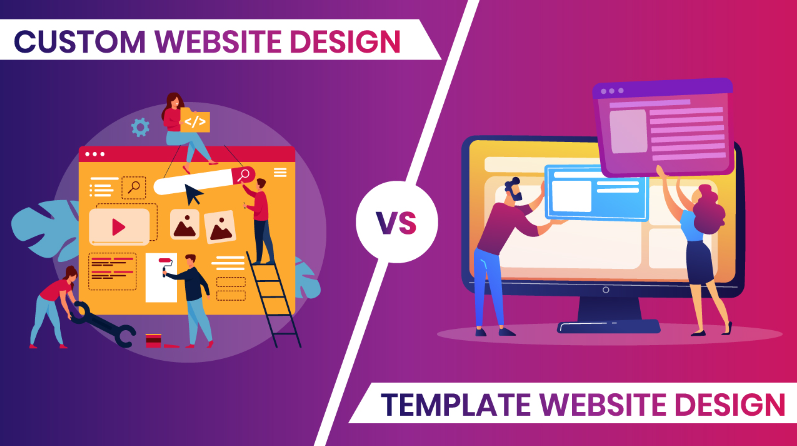
Custom vs Template-Based Websites: Which is Right for Your Sacramento Business?
“`html
Custom vs Template Websites in Sacramento: The Honest Breakdown for B2B Decision-Makers
Your website is your first sales rep. Before a prospect takes a call, reads a case study, or fills out a contact form, they’ve already judged your business by what they saw in the first three seconds on your site. In Sacramento’s increasingly crowded B2B market, that first impression carries real revenue weight.
So the question isn’t just aesthetic. When you’re weighing custom vs template websites in Sacramento, you’re really asking: what level of digital infrastructure does my growth stage actually require? There’s no universal answer — but there is a right answer for your situation. Let’s get into it.
Why This Decision Matters More in 2026
Sacramento’s business landscape has shifted considerably. The metro has absorbed a wave of Bay Area companies relocating for lower overhead, intensifying local competition across sectors like tech, professional services, healthcare, and government contracting. At the same time, Google’s Helpful Content system updates have raised the bar for what a “credible” website looks like — thin, generic template sites are getting penalized in rankings more aggressively than ever before.
Add AI-generated content flooding every industry vertical, and the businesses winning organic search are the ones with technically sound, brand-differentiated, experience-rich websites. That context changes the custom vs template calculus significantly compared to even two or three years ago.
The Real Case for Custom Website Design
A custom website is built from the ground up around your brand, your buyers, and your conversion goals. No compromises inherited from a theme developer who didn’t know your industry existed. Here’s what that actually means in practice:
- Brand precision: Typography, color, layout, and interaction design all reflect your positioning — not a Themeforest bestseller that 40,000 other businesses also purchased. In B2B, where buyers are evaluating credibility before they ever speak to sales, visual differentiation is a trust signal.
- Conversion architecture: Custom builds let you design user flows based on your actual buyer journey. Where does your ICP land? What do they need to see before they’ll request a demo or call? A template forces your buyers into someone else’s assumptions.
- Technical SEO from the foundation: Custom sites give your development team clean, lean code with no bloated plugin dependencies. Core Web Vitals scores — which affect your local Sacramento search rankings — are far easier to optimize when you control the codebase.
- Scalability on your terms: As your service offerings, team, or geography expand, your site expands with intentional architecture. No workarounds. No theme update that breaks half your custom CSS at 2am.
- Security and compliance control: If you handle sensitive client data — common in legal, financial, or healthcare B2B — custom builds let you implement specific security protocols without fighting against a theme’s structural limitations.
The honest tradeoff? Custom costs more upfront and takes longer to launch. For a Sacramento SMB doing under $1M in revenue with no complex integrations, that investment may not be justified yet.
The Real Case for Template-Based Websites
Templates have earned a bad reputation they don’t entirely deserve. A well-configured WordPress or Webflow template, in the right hands, can be a legitimately effective B2B asset — especially for businesses in early growth stages or operating in less competitive niches.
- Speed to market: If you need a credible web presence in 30 days, templates make that possible. For businesses launching a new service line or pivoting positioning, speed matters.
- Lower upfront investment: Premium templates range from $50 to $300. Even with professional configuration and content, total cost can be a fraction of a custom build. For lean teams, that capital is better deployed in demand generation.
- Proven UX patterns: The most popular templates are popular because they work. Buyers recognize conventional navigation structures. When familiarity builds comfort, that’s not a bug — it’s a feature.
- Maintainability: Non-technical founders can update content, add pages, and manage basic SEO without developer dependency. That’s genuinely valuable operational flexibility.
The tradeoffs are real, though. Template sites carry bloated code that drags load speed. They look similar to competitors using the same theme. And customizing them beyond surface-level changes often becomes a more expensive and frustrating exercise than starting from scratch. Sin chamullo — fighting a template’s structure to do something it wasn’t designed for is a tax on your team’s time and your agency’s hourly rate.
The Honest Cost Comparison for Sacramento Businesses
Cost comparisons in web design are almost always misleading because they measure the wrong variable. The question isn’t what you pay to build the site — it’s what you pay per qualified lead generated over a 24-month window.
That said, here’s a realistic 2026 range for the Sacramento market:
- Template-based website (professionally configured): $3,000–$8,000 for design and setup, with $200–$500/month in ongoing maintenance and hosting.
- Semi-custom website (template base, heavy customization): $8,000–$20,000 depending on complexity and integrations.
- Fully custom website: $20,000–$80,000+ for mid-market B2B, depending on scope, CMS, and backend integrations like CRM, marketing automation, or gated content portals.
The mistake most Sacramento founders make is treating the website as a one-time cost rather than a revenue-generating asset. A $4,000 template site that converts at 0.8% is not cheaper than a $35,000 custom site converting at 3.2% — not when you factor in the CAC reduction over 18 months. Claro.
Which Option Fits Where You Are Right Now?
There’s no shame in starting with a template. There’s also no badge of honor in buying a custom site you don’t have the traffic or content strategy to justify. Here’s a practical framework:
Start with a well-built template if:
- You’re pre-product-market fit or in your first two years of operation
- Your primary lead source is referrals and outbound, not inbound SEO
- You need to conserve capital for sales, hiring, or paid acquisition
- Your service offering is still evolving and major site restructuring is likely within 18 months
Invest in a custom build if:
- You’re competing for high-intent Sacramento search terms and organic is a meaningful channel
- Your buying cycle is complex and your site needs to function as an educational, trust-building engine
- You have integrations (CRM, marketing automation, client portals) that templates handle poorly
- Your brand positioning is a core differentiator in your market — and generic template aesthetics actively undermine that
- You’ve hit the ceiling of what your current template site can do
What Sacramento B2B Buyers Actually Notice
We’ve worked with enough Sacramento-based professional services firms, tech companies, and regional contractors to say this with confidence: your buyers are not evaluating your site the way a web designer would. They’re not inspecting the code or caring whether it’s Webflow or WordPress.
What they register — often unconsciously — is load speed, mobile experience, whether the copy speaks to their actual problems, and whether the social proof (case studies, client logos, results) is specific or generic. A thoughtfully executed template that nails all four of those beats a beautiful custom site with vague messaging every time.
That’s why the custom vs template decision should never happen in isolation from your content strategy. The container matters less than what’s inside it. Explore our pillar on Related B2B Growth Topics to see how website strategy connects to your broader demand generation and content infrastructure.
The Bottom Line
For Sacramento B2B businesses, custom vs template websites isn’t a question of prestige — it’s a question of strategic fit. Templates are a legitimate starting point. Custom builds are a legitimate growth investment. The wrong answer is making either decision based on budget alone without considering where your buyers are, what your competitive environment looks like, and what role your website actually plays in your revenue engine.
Build for the business you’re running now, with a clear architectural path to the business you’re building toward.
Not sure which approach fits your growth stage? Talk to our team at Social Peak Media. We work with Sacramento-area B2B companies to align web strategy with content and demand generation — so your site does more than look good. It earns pipeline.
By Jose Villalobos | Social Peak Media
“`